
Anti-Vibration Pad Specifications: Materials, Systems & Technical Data
Which anti-vibration mat is right depends on load, frequency and environment. Here you will find an overview of our systems, load ranges and the most important design rules.
Guide values and product data
The figures on this page are typical values for the material families we supply. They are intended for preselection. We specify the actual product type in the quote – together with the current datasheet (deflection and natural frequency curves, temperature range, media resistance, datasheet issue) and the evidence available for that type.
Our systems at a glance
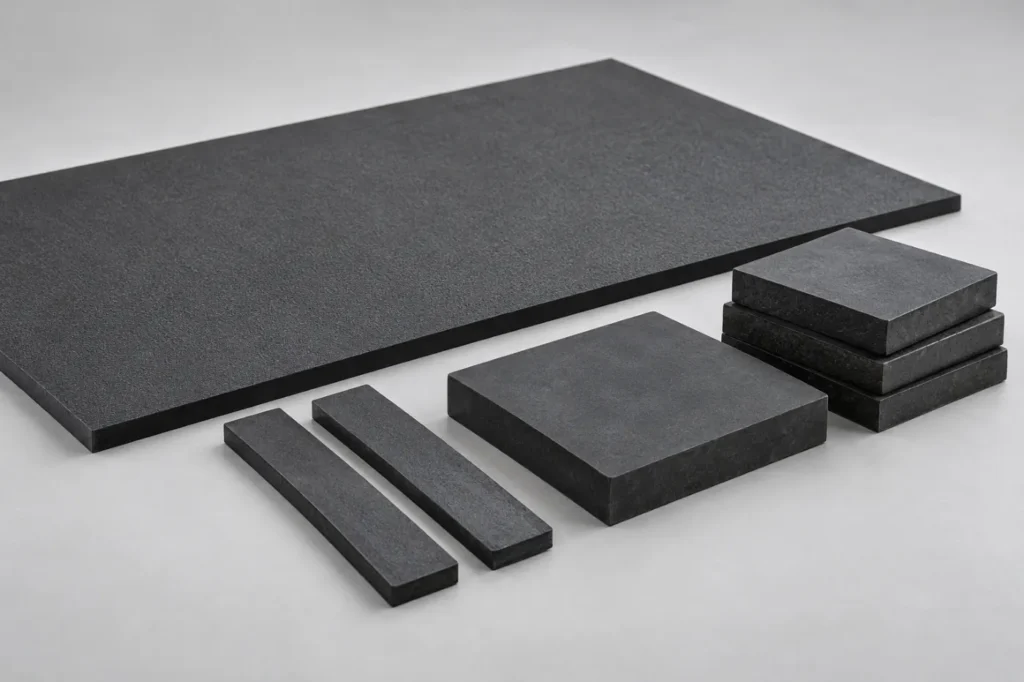
PUR-bonded rubber granulate and fibre mats
- Static continuous loads from approx. 0.02 to 1.5 N/mm² in eight stiffness classes
- Progressive load-deflection curve – almost constant natural frequency over a wide load range
- Natural frequencies from approx. 10 Hz (depending on load and thickness)
- Standard thickness 10 mm, can be laid in one or more layers
- Supplied on the roll (approx. 1.25 m × 8 m) or cut to size, as strips and pads
- Made from recycled rubber – Environmental Product Declarations (EPDs) are available for some types and can be provided on request for the specific type
Mixed-cell PUR elastomers (cellular elastomers)
- Twelve types for static continuous loads from approx. 0.002 to 2.5 N/mm²
- Very low tuning: natural frequencies down to approx. 8 – 10 Hz – even under high loads
- High long-term resilience and low permanent deformation
- Thicknesses up to 50 mm, can be combined in multiple layers
- German general building authority approvals (abZ) are available for selected types – the evidence is assigned to the relevant type in the quote
- Ideal for building services, heat pumps, machines and resilient building isolation
Load classes: rubber granulate and fibre mats
G1 to G8 are our reference classes for preselection. In the quote, we assign a specific, available product type with datasheet to each class.
| Stiffness class | Static continuous load up to | Typical applications |
|---|---|---|
| G1 – very soft | 0.02 N/mm² (2.9 psi) | light equipment, impact sound, light building services |
| G2 | 0.05 N/mm² (7.3 psi) | Ventilation units, small heat pumps, screed isolation |
| G3 | 0.10 N/mm² (14.5 psi) | Air-conditioning units, pumps, plant rooms |
| G4 | 0.12 N/mm² (17.4 psi) | Units on plinths, dry coolers |
| G5 | 0.15 N/mm² (21.8 psi) | Compressors, standby generators |
| G6 | 0.30 N/mm² (43.5 psi) | Machine foundations, transformers, machine tools |
| G7 | 0.80 N/mm² (116 psi) | heavy machines, presses, large transformers |
| G8 – very stiff | 1.50 N/mm² (218 psi) | Heavy duty, point loads, punches, foundation bearings |
📄 Download the rubber granulate mats G1–G8 datasheet (PDF, German) – two compact pages, with a worked example.
Load capacity per pad size (rubber granulate G1–G8)
The table shows the static continuous load a single square pad can carry in each load class up to the upper class limit – calculated as bearing pressure × pad area ÷ 9.81 and rounded, with pounds (lb) in brackets for international readers. For good isolation, the pad should be loaded in the middle to upper part of its class, i.e. not much below these values.
| Class | Continuous load up to | Pad 50 × 50 mm | Pad 100 × 100 mm | Pad 150 × 150 mm | Pad 200 × 200 mm |
|---|---|---|---|---|---|
| G1 | 0.02 N/mm² (2.9 psi) | approx. 5 kg (11 lb) | approx. 20 kg (44 lb) | approx. 46 kg (101 lb) | approx. 82 kg (181 lb) |
| G2 | 0.05 N/mm² (7.3 psi) | approx. 13 kg (29 lb) | approx. 51 kg (112 lb) | approx. 115 kg (254 lb) | approx. 204 kg (450 lb) |
| G3 | 0.10 N/mm² (14.5 psi) | approx. 25 kg (55 lb) | approx. 102 kg (225 lb) | approx. 229 kg (505 lb) | approx. 408 kg (899 lb) |
| G4 | 0.12 N/mm² (17.4 psi) | approx. 31 kg (68 lb) | approx. 122 kg (269 lb) | approx. 275 kg (606 lb) | approx. 489 kg (1,078 lb) |
| G5 | 0.15 N/mm² (21.8 psi) | approx. 38 kg (84 lb) | approx. 153 kg (337 lb) | approx. 344 kg (758 lb) | approx. 612 kg (1,349 lb) |
| G6 | 0.30 N/mm² (43.5 psi) | approx. 76 kg (168 lb) | approx. 306 kg (675 lb) | approx. 688 kg (1,517 lb) | approx. 1,223 kg (2,696 lb) |
| G7 | 0.80 N/mm² (116 psi) | approx. 204 kg (450 lb) | approx. 815 kg (1,797 lb) | approx. 1,835 kg (4,045 lb) | approx. 3,262 kg (7,191 lb) |
| G8 | 1.50 N/mm² (218 psi) | approx. 382 kg (842 lb) | approx. 1,529 kg (3,371 lb) | approx. 3,440 kg (7,584 lb) | approx. 6,116 kg (13,483 lb) |
Simplified calculation, guide values for static continuous load per pad – the binding design is always project-specific. Shock loads, dynamic forces and uneven load distribution (e.g. off-centre centre of gravity) must be derated or considered separately. Example: a 1,200 kg machine on four 150 × 150 mm pads loads each pad with approx. 300 kg – which is within class G5 (up to approx. 344 kg per pad). Check your values with the isolation calculator.
Load classes: PUR elastomers
| Load range | Static continuous load up to | Achievable natural frequency* |
|---|---|---|
| very light | 0.011 – 0.028 N/mm² | down to approx. 9 Hz |
| light | 0.042 – 0.055 N/mm² | down to approx. 9 Hz |
| medium | 0.11 – 0.22 N/mm² | down to approx. 8 Hz |
| medium-heavy | 0.30 – 0.45 N/mm² | approx. 8 Hz |
| heavy | 0.60 – 0.85 N/mm² | approx. 8 – 9 Hz |
| very heavy | up to 2.5 N/mm² (363 psi) | approx. 8 Hz |
* Depending on load, thickness and number of layers. All values are guide values for static continuous load; short-term peak loads may be higher. The binding design is always project-specific.
📄 Download the PUR elastomers datasheet (PDF, German) – two compact pages, with a worked example.
How to choose the right load class
- Calculate the bearing pressure: weight [kg] × 9.81 ÷ loaded area [mm²] = bearing pressure [N/mm²] (1 N/mm² ≈ 145 psi)
- Choose the load class: the material should work in the middle to upper part of its permissible continuous load – under-loaded mats are too stiff and isolate poorly.
- Check the frequency: the natural frequency of the mounting must be well below the excitation frequency (ratio > √2, preferably ≥ 3).
- Adjust the area: if the pressure is too low, the mat is not laid over the full area but as strips or pads – this raises the pressure into the optimum range.
→ Try our online calculator for bearing pressure and isolation efficiency.
→ All data in one compact PDF: Download the technical datasheet (German)
Elastomers compared
| Material | Strengths | Limitations |
|---|---|---|
| Natural rubber (NR) | very good elasticity and dynamic properties, low settlement | not oil-resistant and only partly weather-resistant |
| SBR | cost-effective, good mechanical properties | not oil-resistant |
| EPDM | very good weather, ozone and UV resistance | not resistant to mineral oils and greases |
| NBR | resistant to oils, greases and fuels | limited ozone and UV resistance |
| CR (chloroprene) | balanced: weathering, oil, flame retardancy | moderate low-temperature flexibility |
| Silicone (VMQ) | very wide temperature range, physiologically safe | lower mechanical strength |
| PU / PUR | very high load capacity and abrasion resistance | watch out for hydrolysis with permanently hot water |
Media resistance at a glance
| Material | Mineral oils, greases | Ozone, UV, weathering | Temperature |
|---|---|---|---|
| Natural rubber (NR) | not resistant | limited | medium range; accelerated ageing in heat |
| SBR | not resistant | limited | medium range |
| EPDM | not resistant | very good | good, even at elevated temperatures and in hot water |
| NBR | good | limited | medium range |
| CR (chloroprene) | medium | good | medium range, moderate low-temperature flexibility |
| Silicone (VMQ) | limited | very good | very wide range, high and low |
| PU / PUR | good | good | medium range; watch out for hydrolysis with permanently hot water |
Qualitative guidance for the material families. Actual resistance depends on compound, medium, concentration, temperature and exposure time; always have coolants, acids and alkalis checked case by case. Rubber granulate mats consist mainly of recycled rubber and are generally not designed for permanent oil contact. Fire behaviour and temperature range depend on the type – details are given in the datasheet of the product type named in the quote.
📄 Download the elastomer sheets & pads datasheet (PDF, German) – two compact pages, with a selection table.
Shore hardness – what it tells you
Shore A hardness describes the resistance of the surface to penetration by a standardised indenter (ISO 7619). Elastomers for vibration engineering are usually between approx. 30 and 90 Shore A – typical values are around 45 (soft), 55 (medium) and 70 Shore A (hard). For the design, however, hardness alone is not decisive, but the load-deflection curve of the element: it determines static deflection and natural frequency.
Long-term behaviour: settlement, creep, compression set
Under continuous load, elastomers not only deform immediately but also continue to deform slowly. This creep leads to settlement of the mounted machine. With many elastomers, a large part of it occurs in the initial period after loading; after that, the increase is much slower. How much a mounting settles overall depends on the material, bearing pressure, thickness, temperature and duration of loading.
An important parameter for recovery is the compression set to ISO 815: it describes what proportion of a defined compression remains permanently after unloading. A low value indicates good long-term behaviour. Specific values for creep and compression set can be found in the datasheet of the relevant product type; the Standards & guidelines page gives an overview of the test standards.
- Stay within the recommended load range: overloading significantly increases settlement and creep.
- Allow for initial settlement: check the alignment of couplings, shafts and connections after the first period of operation.
- Consider the environment: heat, oil, ozone and UV accelerate the ageing of unsuitable materials.
- Inspect regularly: visible cracks, hardening, swelling or uneven settlement are signs that replacement is needed.
Installation and application rules
- Load elastomer bearings in compression wherever possible – shear is usually permissible, but tension permanently damages the material.
- Ensure full-surface support: a flat, clean base with no foreign objects between bearing and substructure.
- Distribute the load as evenly as possible and match the bearings to the machine’s centre of gravity to avoid rocking modes.
- Install without excessive force and do not damage surfaces with tools.
- With many elastomers, a large part of the settlement occurs in the first few days under load; the creep curve of the material concerned is decisive. Check and readjust precisely aligned machines (e.g. couplings, shafts) after initial settlement.
- Make rigid connections (pipes, cable trays, bolts) resilient as well – otherwise acoustic bridges are created.
- Check media and temperatures in advance and choose the material accordingly.
Frequently asked questions
Why does rubber insulate structure-borne noise better than concrete or steel?
Sound travels much more slowly in rubber than in concrete or steel. In addition, the elastomer converts part of the vibration energy into heat. A resilient interlayer therefore interrupts the transmission path between machine and structure.
What happens if the mat is under-loaded?
Then it hardly deflects, the natural frequency remains high and the isolation effect is low. The solution is a softer load class or a smaller support area (strips or pads).
Can I lay several layers on top of each other?
Yes. Several layers increase the static deflection and lower the natural frequency. The layers should be laid over the full area and secured against displacement.
What is compression set, and why does it matter?
Compression set indicates what part of a compression remains permanently after unloading; it is tested to ISO 815. A low value means that the bearing retains its height and spring effect well over a long period. The value for a specific type – if tested – can be found in the datasheet; our glossary explains the term.
How much does a mat settle over the years?
That depends on the material, bearing pressure, temperature and duration of loading. With many elastomers, a large part of the settlement occurs in the initial period under load; after that, creep is much slower. Operating the mat within the recommended load range limits settlement; the creep curve in the datasheet of the product type is decisive.
What fire classification do the materials have?
Fire behaviour depends on the material and type. We state in the quote whether, and which, classification is available for a product type – for example for rail vehicles to EN 45545-2. You will find an overview of the standards under Standards & guidelines.
Rubber granulate mat or PUR elastomer – what is the difference?
Rubber granulate mats cover static continuous loads from approx. 0.02 to 1.5 N/mm² in eight classes and achieve natural frequencies from approx. 10 Hz – an economical solution for many machines. PUR elastomers range from approx. 0.002 to 2.5 N/mm², allow lower tuning down to approx. 8–10 Hz and show low permanent deformation. An estimate with the isolation calculator shows which solution suits you.
Are recycled rubber mats suitable for contact with oil or coolant?
Rubber granulate mats made from recycled rubber are generally not designed for permanent contact with mineral oil or coolants. For regular contact, an oil-resistant material such as NBR or a build-up that protects the mat from the medium is recommended. Tell us the medium in your quick quote – we will check the resistance for the specific type.
Have your mounting designed by us
Send us the weight, footprint and speed – we will recommend the right system and load class.
Applications: Transformers · Pumps & Compressors · CNC Machines & Presses · HVAC & Heat Pumps · Railway & Transport · Shipbuilding & Offshore · Buildings & Foundations · Laboratories & Research
Knowledge & tools: Downloads (PDF) · Materials & technical data · Isolation calculator · Mat, mount or spring? · Mat not working? · Standards & guidelines · Glossary · FAQ · Quote configurator