
Anti-Vibration Pads & Mats for Pumps & Compressors
Quieter, gentler, longer-lasting: we isolate pumps, compressors, generators and plant with made-to-measure anti-vibration solutions.
✓ Engineered selection
based on your machine data
✓ Cut to size
mats, strips, pads & multi-layer systems
✓ Fast quotes
short-notice production & express possible
✓ Industry & research
we also supply leading universities & institutes
What natural frequency does your mounting need? → Try the free vibration isolation calculator
Stop vibration from plant at the source
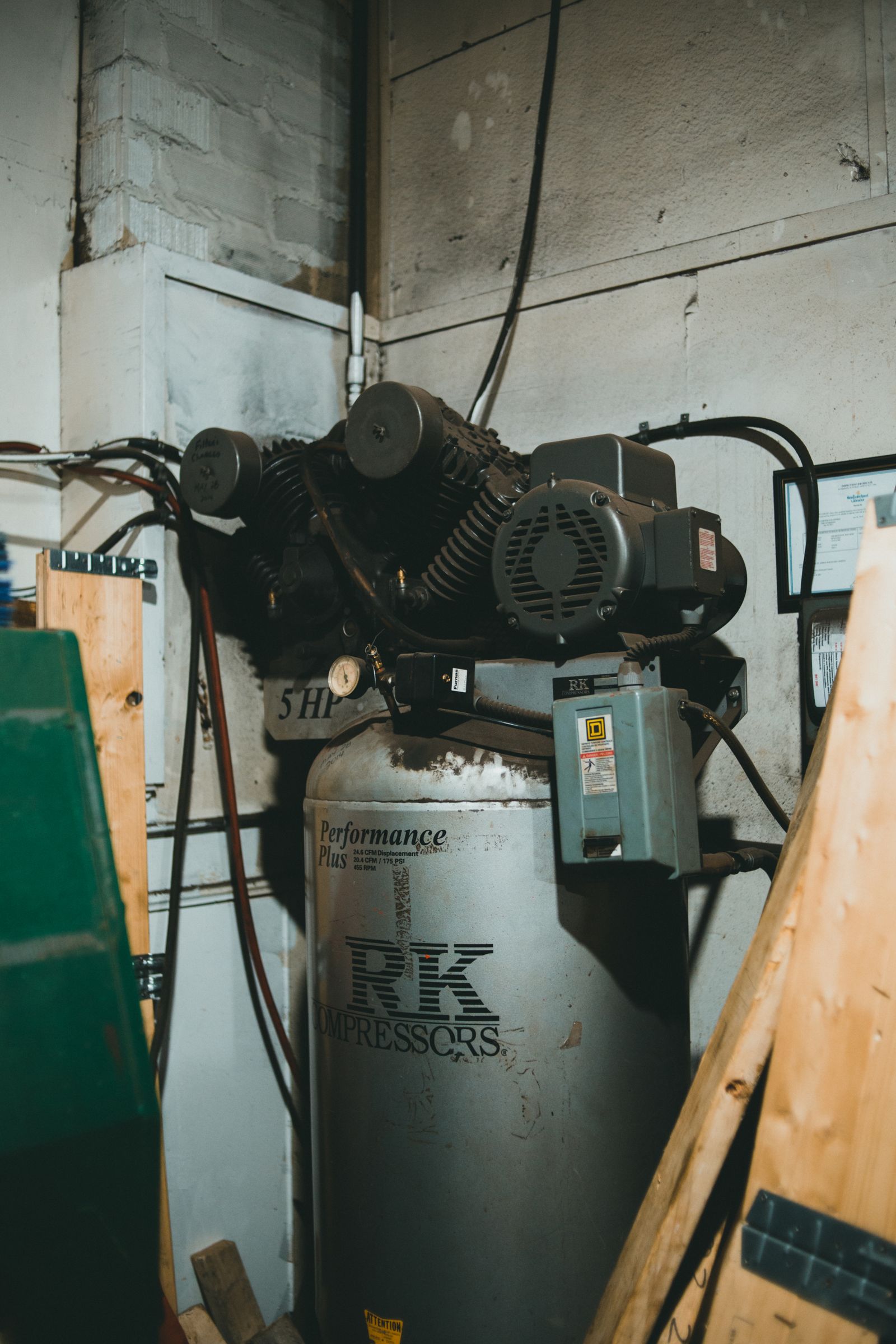
Pumps and compressors work with rotating or reciprocating masses. The resulting vibration is transmitted via the base frame and floor into pipework, the building and neighbouring machines. The consequences: noise in plant rooms and adjoining areas, loosened connections, increased wear on bearings and seals, and unplanned downtime.
Reduce structure-borne noise
Rubber and elastomers transmit structure-borne noise far less than steel or concrete – the noise path into the building is interrupted.
Reduce wear
Less vibration means less stress on bearings, seals, pipe connections and foundations.
Slip-resistant & stable
Anti-vibration mats provide a secure, slip-resistant installation – even with varying loads.
Typical applications
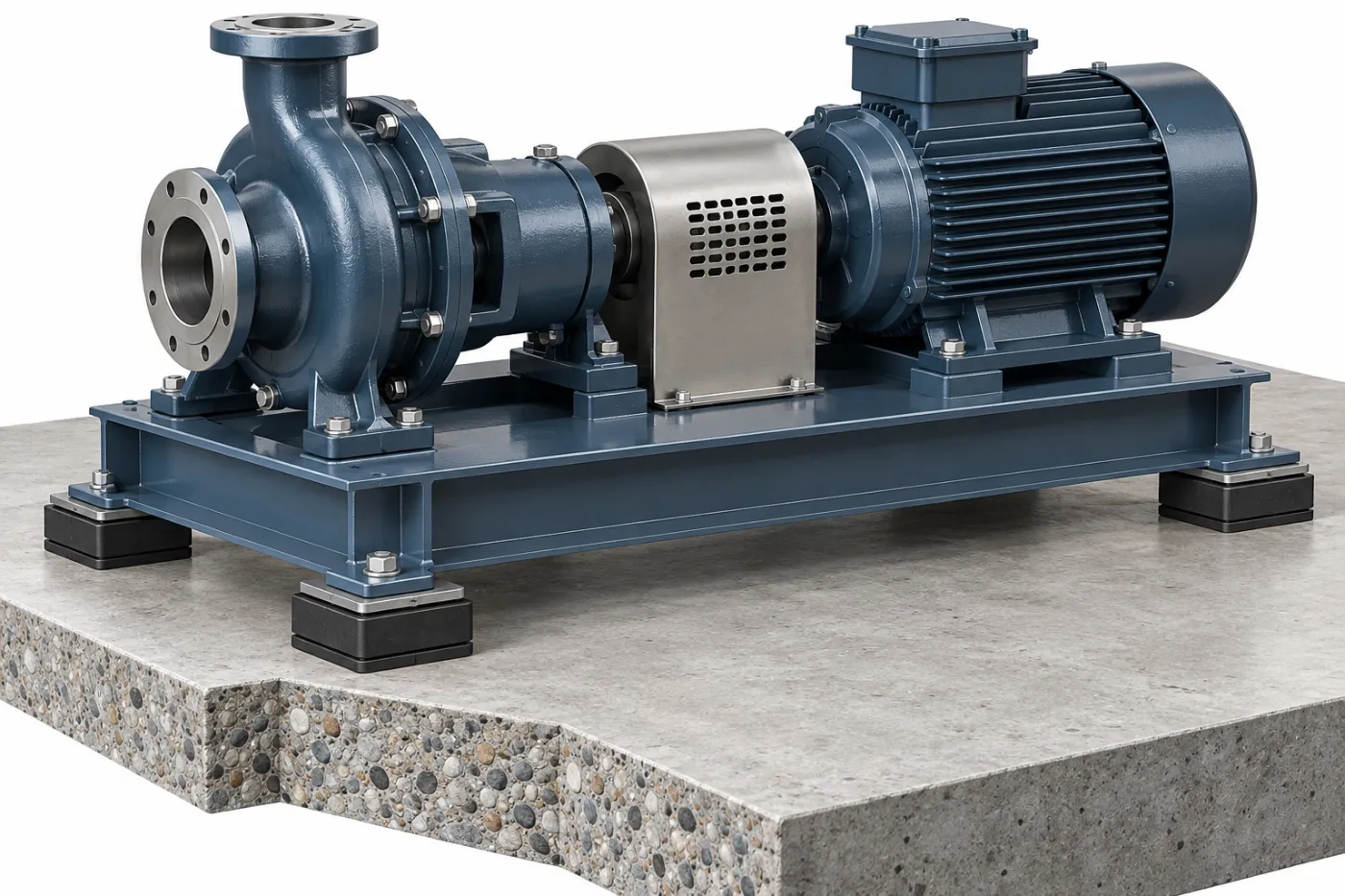
Our anti-vibration mats are used under plant such as:
- Screw and reciprocating compressors
- Centrifugal, circulating and booster pumps
- Vacuum pumps and blowers
- Standby generators and combined heat and power (CHP) units
- Chillers and dry coolers
- Compressor stations and hydraulic power units
The right material for your plant
Whether it is a light pump in a plant room or a heavy compressor in an industrial hall: we select the material, hardness and thickness to suit the weight, speed and ambient conditions.
- NBR / PU for environments with oil and grease
- EPDM for outdoor installation
- Silicone for high temperatures and for food and medical technology
- Heavy-duty mats up to 50 mm thick and multi-layer systems
Recommended systems & technical data
A unit running at 1,500 rpm produces an excitation frequency of 25 Hz. For 80 % isolation efficiency, the natural frequency of the mounting must be no more than approx. 10 Hz; for 90 %, approx. 7 Hz. That is why we often use low-tuned PUR elastomers or multi-layer mat build-ups here. At very low speeds, a spring element may be the better choice – see our guide Mat, mount or spring?
| Recommended system | Load range (static continuous load) | Suitable for |
|---|---|---|
| PUR elastomer, medium to medium-heavy | 0.11 – 0.45 N/mm² | Compressors, pumps, blowers – natural frequencies down to approx. 8 Hz |
| Rubber granulate/fibre mat, class G3 – G6 | 0.10 – 0.30 N/mm² | Pumps and plant on base frames and plinths |
| NBR/PU pads | as designed | environments with oil and grease |
- Connect pipework via expansion joints or flexible hoses
- At low bearing pressure, use strips or pads instead of a full-surface mat
- Allow for run-up and run-down (passing through resonance) in the design
→ All load classes: Materials & technical data · Check your own values: Isolation calculator
Relevant datasheets (PDF, German): Rubber granulate mats G1–G8 · PUR elastomers · Elastomer sheets & pads
Worked example: centrifugal pump on a base frame
Simplified example, guide values only – the binding design is always project-specific. The example shows why pumps running at around 1,450 rpm usually need low-tuned materials.
| Quantity | Assumption / calculation | Result |
|---|---|---|
| Unit | Centrifugal pump with motor on a base frame, operating weight 500 kg, 4 pads 100 × 100 mm | Support area 4 × 10,000 mm² = 40,000 mm² |
| Bearing pressure | 500 kg × 9.81 / 40,000 mm² | ≈ 0.12 N/mm² → rubber granulate class G5 (up to 0.15 N/mm²) or medium PUR elastomer |
| Excitation frequency | 1,450 rpm / 60 | ≈ 24 Hz |
Comparison of two mountings at an excitation frequency of 24 Hz:
| Mounting | Natural frequency f0 (assumed) | Frequency ratio η | Isolation efficiency | Level reduction |
|---|---|---|---|---|
| Rubber granulate G5 | approx. 12 Hz (guide value for granulate: from approx. 10–15 Hz) | ≈ 2.0 | ≈ 67 % | ≈ 10 dB |
| PUR elastomer, medium | approx. 8 Hz (guide value for PUR: down to approx. 8–10 Hz) | ≈ 3.0 | ≈ 88 % | ≈ 18 dB |
Calculation: isolation efficiency = 1 − 1/(η² − 1) with η = excitation frequency / natural frequency; dB = 20 · log10(1/transmissibility). The values apply to an undamped single-mass model on a rigid base; rigidly connected pipework or flexible floor slabs reduce the effect. There are dedicated standards for assessing machine vibration – see Standards & guidelines.
→ Check your own values in the isolation calculator
How your project works
1. Enquiry
Tell us about your machine or plant, its weight, footprint and speed – the easiest way is via our configurator.
2. Design
We select material, hardness, thickness and format to suit the load and frequency and agree the solution with you.
3. Manufacture
Your anti-vibration mats or pads are cut to size – as a mat, strips, pads or a multi-layer system.
4. Delivery
You receive ready-to-install elements that can be fitted under machines and foundations with little effort. Made and shipped from Germany – EU-wide delivery; UK delivery DAP/DDP on request (customs handled).
Frequently asked questions
Is a simple rubber mat under the compressor enough?
A mat that is too hard or too soft can be ineffective or even amplify vibration. What matters is tuning to the weight and speed – and that is exactly what we design the mat for.
Does the pump have to be bolted to the floor?
That depends on the application and safety requirements. We will advise you whether free-standing installation or fixing with resilient elements makes sense.
Do you also supply special formats?
Yes. We make to measure – as a full-surface mat, strips or pads to suit your base frame.
How do I isolate the pipework?
Pipework should be connected to the resiliently mounted unit via expansion joints, such as rubber or metal bellows, or flexible hoses. Rigidly connected pipes act as a acoustic bridge and carry vibration past the mounting into the building. Resilient pipe clips at the first fixing points also help.
What is different about a reciprocating compressor compared with a screw compressor?
Screw compressors run largely smoothly; the rotational frequency is the main factor. Reciprocating compressors produce much larger, pulsating forces due to the oscillating masses, sometimes also at multiples of the rotational frequency and at low speeds. They therefore usually need lower tuning, more load reserve and often an additional mass or an inertia base.
Do I need an inertia base?
An inertia base – a heavy concrete or steel plinth between the unit and the mounting – reduces vibration amplitudes, improves stability and spreads the load more evenly over the mats. It is particularly useful for reciprocating compressors, large pumps with high unbalance forces or light units on soft mountings. For many centrifugal pumps on a stiff base frame, direct mounting is sufficient.
What applies to variable speed with a frequency inverter?
For variable-speed units, the lowest operating speed is decisive, because that is where the frequency ratio is smallest. The mounting must be tuned low enough that even this speed is still well above √2 times the natural frequency. If that cannot be achieved, a critical frequency band can be skipped in the inverter. So please tell us the full speed range.
Which frequency do I use if there are several sources of excitation?
Pumps and compressors often have several excitation frequencies: motor and pump speed, different shaft speeds with belt or gear drives, and the blade-pass frequency (rotational frequency × number of blades). The lowest relevant frequency governs the tuning; higher frequencies are then generally isolated as well. You can check each frequency separately in the isolation calculator.
What thickness of anti-vibration mat do I need for a compressor?
There is no single right thickness – what matters is the load class and the natural frequency the mounting reaches under your compressor’s weight. Our rubber granulate mats come in a standard thickness of 10 mm and can be laid in several layers; PUR elastomers are available up to 50 mm. For a compressor running at 1,500 rpm (25 Hz), the mounting should reach about 7–10 Hz for 80–90 % isolation, which usually calls for a low-tuned PUR elastomer or a multi-layer build-up rather than simply a thicker mat. Send us the weight, footprint and speed via the quick quote and we will specify the build-up.
Is your plant too noisy?
Tell us the type, weight and speed – we will recommend the right anti-vibration mat.
🗣️ We can advise you in English, German and French – our team includes English- and French-speaking staff.
Short on time? The quick quote is enough to get started. Prefer more detail? Use our quote configurator or contact us directly. Want to test the material first? Order a material sample – just select the sample option in the quick quote form.
More applications: Transformers · CNC Machines & Presses · HVAC & Heat Pumps · Railway & Transport · Shipbuilding & Offshore · Buildings & Foundations · Laboratories & Research
Knowledge & tools: Materials & technical data · Isolation calculator · Mat, mount or spring? · Mat not working? · Downloads · FAQ · About us