
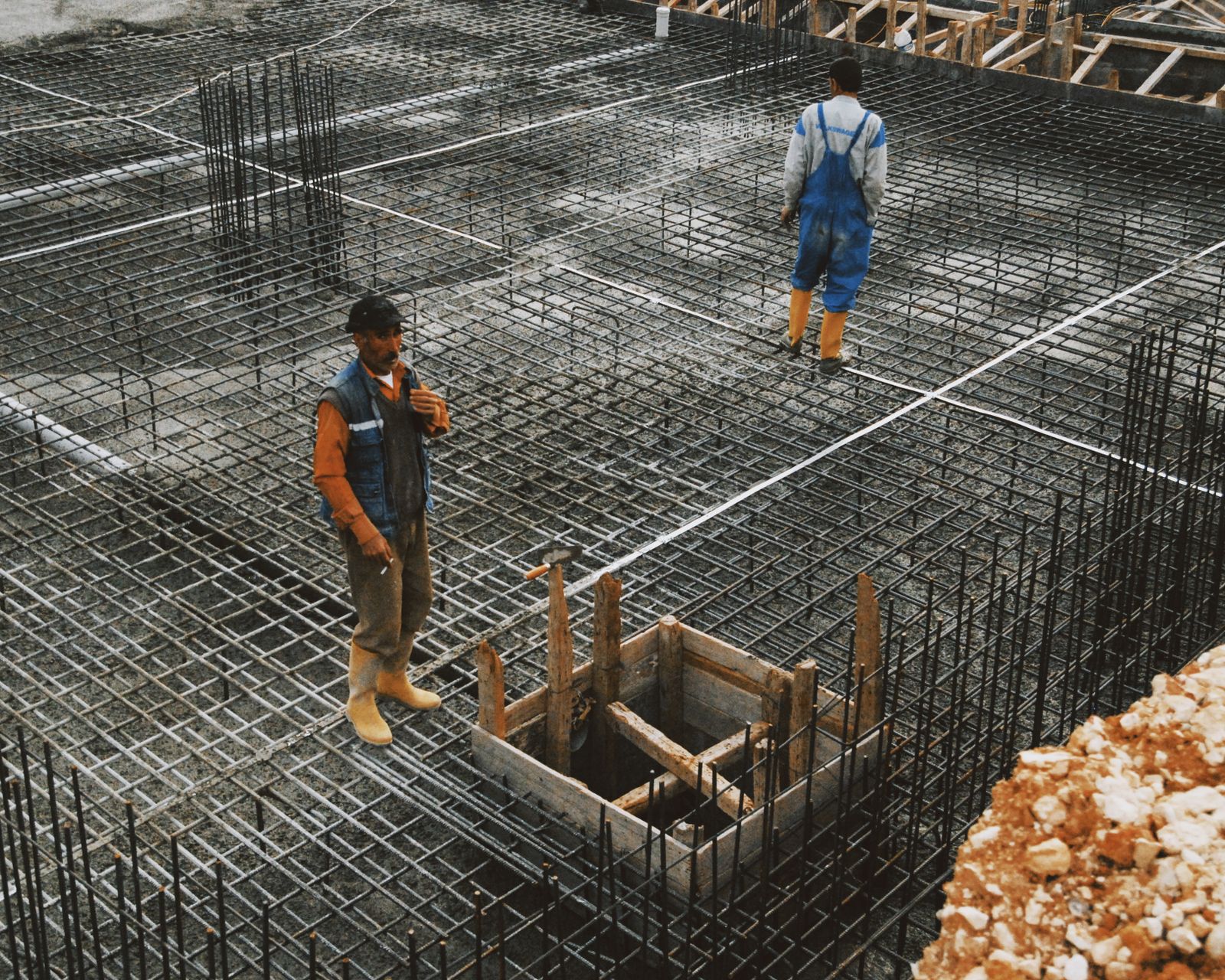
Resilient Bearings for Buildings & Foundations
Vibration isolation for buildings, machine foundations, bridges and swimming pools – designed, specified and supplied made to measure.
✓ Engineered selection
based on your machine data
✓ Cut to size
mats, strips, pads & multi-layer systems
✓ Fast quotes
short-notice production & express possible
✓ Industry & research
we also supply leading universities & institutes
What natural frequency does your mounting need? → Try the free vibration isolation calculator
Vibration protection starts at the foundation
Traffic, machines or neighbouring plant generate vibration that travels through the ground into buildings. Conversely, machine foundations transmit vibration to their surroundings. A resilient bearing between the structural element and the ground interrupts this transmission path – most effectively when it is considered at the design stage.
Protection against vibration
Resiliently supported buildings and foundations are protected from vibration caused by traffic and the surroundings.
Transfer loads safely
Elastomer bearings carry loads from slabs, beams and roofs and accommodate rotation and horizontal movement.
Design certainty
We support you with design, datasheets and specification texts for your bill of quantities.

Typical applications
Typical applications in construction and infrastructure:
- Vibration-isolating building and concrete foundations
- Elastomer bearings in concrete and reinforced concrete construction (slabs, beams, roofs)
- Bridge bearings and civil engineering structures
- Tunnels
- Swimming pools, e.g. in spas and hotels
- Impact sound insulation for floors and walls
Our solution: resilient bearings with evidence
For resilient building isolation, we mainly use mixed-cell PUR elastomers: they achieve natural frequencies down to approx. 8 – 10 Hz even under high loads, remain permanently resilient and selected types are available with a German general building authority approval (abZ).
- Full-surface base slab and foundation bearings
- Strip and point bearings under walls and columns
- Lateral isolation of building elements
- Datasheets and specification texts for design and tendering
Recommended systems & technical data
The selection depends on bearing pressure, the required tuning frequency and the building element. Particularly stiff types are available for high loads.
| Recommended system | Load range (static continuous load) | Suitable for |
|---|---|---|
| PUR elastomer, light to very heavy | 0.042 – 2.5 N/mm² | Building and base slab isolation, foundations – natural frequencies down to approx. 8 Hz |
| Rubber granulate/fibre mat, class G1 – G8 | 0.02 – 1.50 N/mm² | Foundations, screed and impact sound isolation |
| Elastomer bearings (CR, NR) | as designed | Slab, beam and bridge bearings |
- Lay the bearing over the full area, tape the joints and provide a protective layer against cement slurry
- Consistently isolate flanking transmission and penetrations
- Specification texts and the datasheet are available in the downloads section
→ All load classes: Materials & technical data · Check your own values: Isolation calculator · Specification texts & datasheet (PDF, German)
Relevant datasheets (PDF, German): PUR elastomers · Rubber granulate mats G1–G8
Worked example: resiliently mounted machine foundation
How can a machine foundation be estimated? The following simplified example looks at a machine running at 1,500 rpm on an inertia base supported over its full area on PUR elastomer.
- Machine mass: 8 t; foundation block according to the rule of thumb “approx. three times the machine mass”: 24 t; total mass 32 t
- Base area of the foundation: 3.0 × 2.0 m = 6,000,000 mm²
- Bearing pressure: 32,000 kg × 9.81 / 6,000,000 mm² ≈ 0.05 N/mm² – within the load range “PUR elastomer, light to very heavy” (0.042 – 2.5 N/mm²) from the table above, i.e. a light type
- Excitation frequency: 1,500 rpm ÷ 60 = 25 Hz
- Assumed natural frequency of the mounting: 10 Hz or 8 Hz
The calculation uses the undamped single-degree-of-freedom system: η = excitation frequency / natural frequency, T = 1 / (η² − 1), isolation efficiency = 1 − T, level reduction = 20 · log10(1/T) dB.
| Mounting | Frequency ratio η | Isolation efficiency | Level reduction |
|---|---|---|---|
| f₀ = 10 Hz | 2.5 | ≈ 81 % | ≈ 14 dB |
| f₀ = 8 Hz | ≈ 3.1 | ≈ 89 % | ≈ 19 dB |
What the example shows: the foundation mass does not change the isolation efficiency directly – that depends on the frequency ratio. But it reduces the vibration amplitudes of the machine, compensates for an off-centre centre of gravity and ensures that the bearing works in the right load range. It is important that the bearing pressure suits the chosen type: an under-loaded bearing is too stiff and does not reach the assumed natural frequency. Guidance on assessing vibration can be found on our Standards & guidelines page.
Simplified example, guide values only – the binding design is always project-specific. Check your own values with the isolation calculator. You can request a material sample via the quick quote form.
How your project works
1. Enquiry
Tell us about your machine or plant, its weight, footprint and speed – the easiest way is via our configurator.
2. Design
We select material, hardness, thickness and format to suit the load and frequency and agree the solution with you.
3. Manufacture
Your anti-vibration mats or pads are cut to size – as a mat, strips, pads or a multi-layer system.
4. Delivery
You receive ready-to-install elements that can be fitted under machines and foundations with little effort. Made and shipped from Germany – EU-wide delivery; UK delivery DAP/DDP on request (customs handled).
Frequently asked questions
When should resilient building isolation be planned?
As early as possible – ideally at concept design stage. The bearing affects the foundations, structural design and details; retrofitting is usually very costly.
Do you supply specification texts?
Yes. Model clauses for bills of quantities are available in the downloads section (currently in German); on request we can adapt them to your project, for example as NBS-style clauses.
Are the mats also suitable for swimming pools?
Yes. Resilient bearings are used, for example, in spas and hotels to separate structure-borne noise from pools and plant from the building.
Which standards cover vibration in buildings?
In the UK, BS 6472-1 deals with the evaluation of human exposure to vibration in buildings (1 Hz to 80 Hz), BS 7385-2 with vibration levels relevant to building damage, and BS 5228-2 with vibration from construction work. The German DIN 4150 series “Vibration in buildings” covers the same topics in three parts: Part 1 prediction of vibration parameters, Part 2 effects on people in buildings and Part 3 effects on structures. Please take the guide and assessment values directly from the standards. Our Standards & guidelines page gives an overview of further standards.
How is a machine foundation resiliently supported?
The usual approach is a pit in the ground slab whose base and side walls are lined over their full area with the resilient bearing. The joints are taped, a protective membrane prevents cement slurry from penetrating joints and bearing, and then the foundation block is installed or cast. The perimeter joint is kept free of debris and concrete and sealed with a permanently elastic sealant so that no acoustic bridges are created. Suitable materials can be found under Materials & technical data.
How heavy should the foundation be relative to the machine?
As a rule of thumb – cited, for example, in a handout from a DGUV (German Social Accident Insurance) technical event on structure-borne noise isolation – a foundation mass of about three times the machine mass is given. The additional mass reduces vibration amplitudes, lowers the combined centre of gravity and spreads the load more evenly. For machines with impact loading, such as presses, sizing is project-specific.
How are services and penetrations detailed on resiliently supported elements?
Any rigid connection between the supported element and its surroundings acts as a acoustic bridge. Pipes, cable trays, stairs, shafts and connections to adjoining elements should therefore be flexible or detailed with a resilient joint. These details belong in the detailed design, because they are difficult to correct later.
Can a building also be protected from external vibration?
Yes. As well as mounting the source of disturbance (source isolation), the building or element to be protected can also be resiliently supported (receiver isolation) – for example buildings next to railway lines or tram routes. More on our Railway & transport page.
Construction project needing vibration protection?
Tell us about the structure, loads and source of disturbance – we support you from design through to specification.
🗣️ We can advise you in English, German and French – our team includes English- and French-speaking staff.
Short on time? The quick quote is enough to get started. Prefer more detail? Use our quote configurator or contact us directly.
More applications: Transformers · Pumps & Compressors · CNC Machines & Presses · HVAC & Heat Pumps · Railway & Transport · Shipbuilding & Offshore · Laboratories & Research
Knowledge & tools: Materials & technical data · Isolation calculator · Mat, mount or spring? · Mat not working? · Downloads · FAQ · About us