
Laboratory Vibration Isolation for Microscopes, Balances & Lab Equipment
In laboratories and wherever precise measurements are taken, vibration is a major source of interference that can impair the accuracy and reliability of results. For sensitive measuring instruments such as balances and laboratory equipment, we offer dedicated anti-vibration solutions that provide precise vibration isolation and so safeguard accurate measurement results.
Our customers include many renowned research institutes, colleges and technical universities.
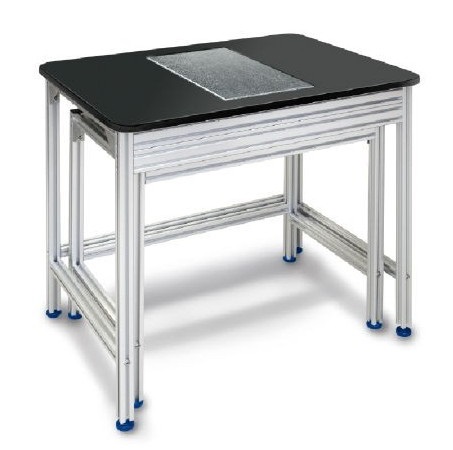
for vibration isolation
Where vibration isolation is used in science and research
For sensitive measuring instruments in laboratories or research facilities, dedicated anti-vibration solutions are needed, because these instruments are often very light.
- Microscopes: the finest image details can be blurred by vibration. Anti-vibration plates made of polished granite, supported on absorbent rubber elements, minimise this interference and improve image quality.
- Balances: analytical and precision balances are sensitive to vibration, which can distort results. Dedicated anti-vibration plates reduce these influences and ensure accurate weighing.
- Analytical instruments: instruments based on electromagnetic or optical principles benefit from a vibration-free environment so that they deliver consistent and reliable data.
For laboratories and research facilities aiming for the highest precision, vibration-isolating anti-vibration mats and plates as well as anti-vibration tables are therefore indispensable for ensuring the quality and reliability of their measurement results.
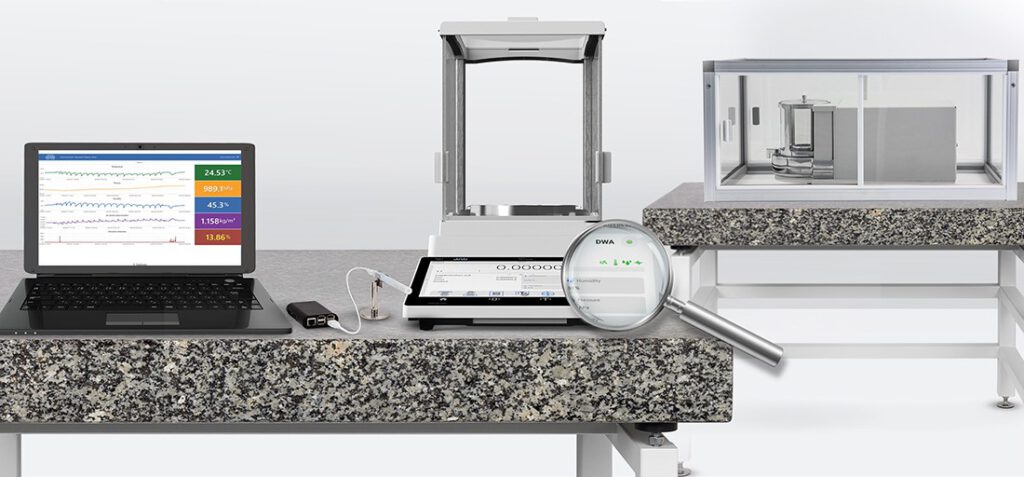
Examples of sensitive measuring, electronic and test equipment that needs to be shielded from external vibration include:
1. Spectroscopic analysers:
- Fourier transform infrared spectrometers (FTIR): identification and characterisation of chemical substances by infrared spectroscopy.
- Mass spectrometers: determination of the mass and structure of molecules by ionisation and analysis of mass-to-charge ratios.
- Nuclear magnetic resonance (NMR) spectrometers: investigation of molecular structure by analysing the magnetic properties of atomic nuclei.
- Raman spectrometers: analysis of molecular vibrations for material identification based on Raman scattering.
- Scanning electron and atomic force microscopes
2. Chromatography and flow analysers:
- Gas chromatographs (GC): separation and analysis of volatile substances in gas samples.
- Coriolis mass flow meters: measurement of the mass flow of liquids and gases based on the Coriolis effect.
- Flow cytometers: analysis of physical and chemical properties of cells or particles in liquids.
3. Microscopy and imaging:
- Microscopes including confocal and light microscopes: magnification and examination of small structures using light.
- Optical comparison microscopes: direct comparison of two samples viewed side by side.
- Scanning electron microscopes (SEM): high-resolution imaging of surface structures using electron beams.
- Thermal imaging cameras: visualisation of temperature distributions on surfaces using infrared radiation.
- Transmission electron microscopes
4. Materials testing and quality control:
- Coordinate measuring machines
- Fatigue testing machines and vibration test systems: evaluation of the fatigue strength of materials under cyclic loading.
- Surface texture testers: measurement and analysis of surface texture and quality.
- Quality control test equipment: various instruments for ensuring product standards and specifications.
- Roughness testers: determination of surface roughness to assess surface quality.
5. Laboratory support equipment:
- Cryostats: devices used to generate and maintain very low temperatures
- Shaking incubators: a combination of shaker and incubator for cultivating microorganisms or cell cultures under controlled conditions.
- Evaporator box with fan: a device for evaporating solvents under controlled conditions, assisted by air circulation.
6. Particle and cell counting:
- Particle counters: detection and counting of particles in liquids or gases to determine particle concentration.
7. Weighing and measuring instruments:
- Balances, e.g. analytical balances and high-precision/laboratory balances: precise weighing of substances for analytical purposes.
8. Other vibration-sensitive laboratory and measuring equipment:
- Equipment whose function can be impaired by external vibration and which therefore requires special installation conditions.
- Vibration isolation for precision metrology centres
Anti-vibration mats are very important for many medical devices, because they reduce unwanted vibration and noise that can impair both the functioning of the equipment and the comfort of patients and staff.
Some examples of such equipment in healthcare are:
- Magnetic resonance imaging (MRI) scanners: these machines generate strong vibration during operation. Anti-vibration mats can help to reduce this vibration and minimise noise nuisance.
- Ultrasound equipment: stable positioning is essential for precise imaging. Anti-vibration mats help absorb movement and vibration, improving image quality.
- Analytical and laboratory equipment: sensitive instruments such as centrifuges or spectrometers benefit from vibration isolation with anti-vibration mats, ensuring accurate and reproducible results.
- Operating theatre equipment: comfort mats, such as the operating theatre mat, are used in operating theatres and emergency departments to increase comfort for medical staff and reduce the strain of standing for long periods. Industrial wholesale supplies (German website)
- Hospital beds and patient couches: anti-vibration mats can be placed under beds to minimise movement and increase patient comfort.
- Hydrojet for dry hydro-massage
The targeted use of anti-vibration mats, feet and tables not only optimises the performance of medical equipment but also creates a quieter, more pleasant environment for patients and medical staff.
Worked example: microscope on a measuring table
Laboratories often struggle with low interference frequencies from the building, for example from building services, traffic or floors people walk on. The following simplified example shows why very low tuning is needed there – and where mats and pads reach their limits.
- Granite plate 150 kg + microscope 50 kg = 200 kg, supported on 4 PUR pads of 50 × 50 mm each (10,000 mm² in total)
- Bearing pressure: 200 kg × 9.81 / 10,000 mm² ≈ 0.20 N/mm² – within the load range of PUR elastomers (0.002 – 2.5 N/mm², see Materials & technical data)
- Assumed natural frequency: approx. 8 Hz with PUR elastomer (very low tuning) compared with approx. 10 Hz, the lower limit for rubber granulate
- Interference frequencies in the building: 10, 15 and 25 Hz
The calculation uses the undamped single-degree-of-freedom system: η = interference frequency / natural frequency, T = 1 / (η² − 1), isolation efficiency = 1 − T, level reduction = 20 · log10(1/T) dB. Isolation only begins at η > √2.
| Interference frequency | PUR elastomer, f₀ ≈ 8 Hz | Rubber granulate, f₀ ≈ 10 Hz |
|---|---|---|
| 10 Hz | η = 1.25 < √2 → no isolation, amplification (≈ +5 dB) | η = 1.0 → resonance, strong amplification |
| 15 Hz | η ≈ 1.9 → ≈ 60 % (≈ 8 dB) | η = 1.5 → ≈ 20 % (≈ 2 dB) |
| 25 Hz | η ≈ 3.1 → ≈ 89 % (≈ 19 dB) | η = 2.5 → ≈ 81 % (≈ 14 dB) |
What the example shows: at 25 Hz, both materials isolate well. At 15 Hz, only the very low-tuned PUR mounting still has a significant effect. Below approx. 11 Hz (8 Hz × √2), mats and pads fundamentally reach their limits – air spring systems or active isolation systems are needed here. Our guide Mat, mount or spring? compares when each system makes sense.
Simplified example, guide values only – the binding design is always project-specific. Check your own values with the isolation calculator. You can request a material sample via the quick quote form.
Frequently asked questions
Which vibration criteria apply to microscopes, balances and measuring instruments?
The manufacturer’s specifications for permissible vibration at the installation site come first. For laboratories and cleanrooms, the VC curves (Vibration Criteria, VC-A to VC-E and beyond) are also frequently used: they grade the permissible vibration velocity in one-third octave bands, from general laboratory areas to highly sensitive equipment. Please take the limit values from the manufacturer’s specifications or the technical literature; our Standards & guidelines page gives an overview.
What does receiver isolation mean, and why is it the norm in laboratories?
With source isolation, the source of disturbance is resiliently mounted; with receiver isolation, the sensitive instrument itself. In a laboratory, the sources of disturbance – traffic, building services, people – usually cannot be influenced, so the instrument or measuring table is mounted. Where possible, it is most effective to also isolate noisy equipment in the same room at the source.
At what interference frequency do anti-vibration mats reach their limits?
With PUR elastomers, natural frequencies down to approx. 8 Hz can be achieved. Isolation only begins above approx. 11 Hz; a clear effect of over 80 % is theoretically achieved from approx. 20 Hz. If the disturbances are lower, for example vibration of lightweight floors, air spring or active systems are needed – see the worked example above.
Why is the right loading so important for light instruments?
An elastomer only reaches its low natural frequency if the bearing pressure is within the intended load range. If a light instrument stands on a large mat, the mat is under-loaded, acts too stiff and isolates correspondingly less well. A few properly sized pads under a table top or granite plate are better – just tell us the weight and footprint.
Does a heavy granite plate under the instrument bring additional benefit?
Yes. The additional mass increases the load on the pads so that they work in the right load range, and makes the set-up less sensitive to forces on the instrument itself, for example from operation or built-in fans. The actual isolation effect, however, comes from the low tuning of the resilient mounting under the plate.
Request a quote for vibration isolation solutions
Step 1: fill in the Excel form (German)
Step 2: email it to us: info@antivibrationsmatten.com
Step 3: receive our quote
Applications: Transformers · Pumps & Compressors · CNC Machines & Presses · HVAC & Heat Pumps · Railway & Transport · Shipbuilding & Offshore · Buildings & Foundations · Laboratories & Research
Knowledge & tools: Materials & technical data · Isolation calculator · Mat, mount or spring? · Mat not working? · Downloads · FAQ · Quote configurator