
Anti-Vibration Mats FAQ – Pads, Mats & Vibration Isolation
Topics: General · Industry · Laboratories & metrology · Installation & storage · Calculator & design
FAQ – anti-vibration mats in general
1. What are anti-vibration mats?
Anti-vibration mats are resilient underlays made of rubber, recycled rubber granulate, polyurethane or special elastomers. They reduce vibration, shocks and structure-borne noise by isolating machines, equipment or measuring instruments from the floor.
2. How do anti-vibration mats and pads work?
Anti-vibration mats are resilient rubber mats or composite materials that effectively reduce vibration, oscillation and shocks. They protect machines, floors and building structures from damage while reducing noise and vibration.
3. What are anti-vibration mats used for?
Anti-vibration mats are used wherever machines, plant or equipment generate vibration and shocks that can adversely affect operation, the surroundings or building structures. They provide vibration damping, vibration isolation and noise reduction – in industrial, commercial and domestic settings.
In industry, anti-vibration mats are often used under CNC machines, lathes and milling machines, compressors, pumps, hydraulic power units, generators, presses or transformers. The resilient mounting prevents vibration from being transmitted to the foundation or neighbouring plant, which significantly reduces maintenance, machine downtime and material fatigue.
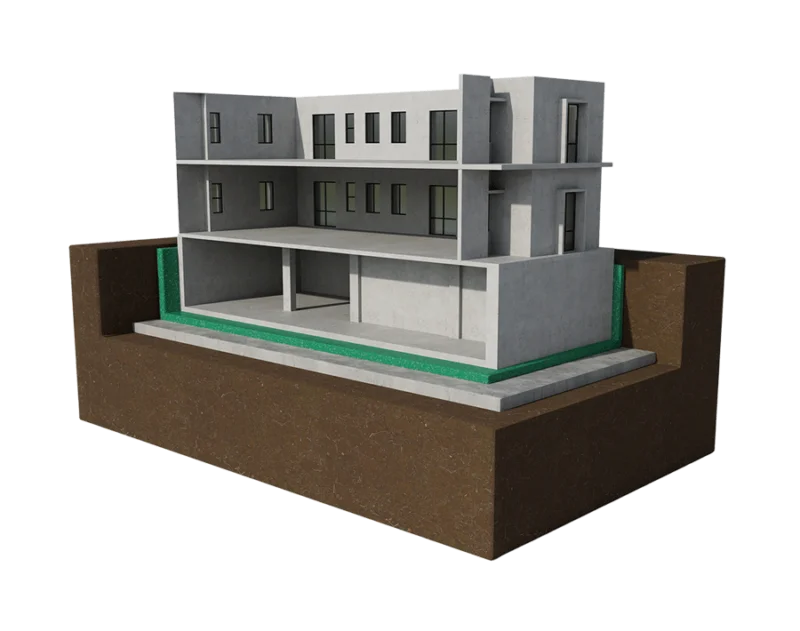
In construction, anti-vibration mats are used for structure-borne noise isolation and isolating foundations, lift shafts, stairwells and plant rooms. They prevent vibration from spreading via load-bearing elements into adjoining rooms – a key contribution to sound insulation and building stability.
In facilities and building management, anti-vibration mats are also used, e.g. under air-conditioning units, ventilation plant, heat pumps, cooling units or washing machines. This reduces disturbing noise and extends equipment life.
In workshops, laboratories and test rigs, the mats prevent vibration from affecting sensitive measuring equipment. In transport and logistics, they protect sensitive equipment or goods from shocks during operation or storage.
In summary, anti-vibration mats provide:
- Lower maintenance requirements
- Effective vibration damping and structure-borne noise isolation
- Stable and safe machine operation
- Noise reduction and better occupational safety
- Protection of building structures and foundations
4. What are the benefits of anti-vibration mats?
- Reduction of vibration and noise
- Protection of machines and foundations
- Longer plant life
- Better working environment
- Easy installation without special tools
5. Are there different thicknesses and sizes?
Yes, anti-vibration mats are available in various thicknesses (5–50 mm) and sheet formats. Custom cut sizes to customer specification are also possible – ideal for machine foundations or special structures.
Do anti-vibration pads reduce noise as well as vibration?
Partly. Anti-vibration pads and mats reduce structure-borne noise – the vibration that travels through floors, walls and pipework and is re-radiated elsewhere as a hum. They do not reduce the airborne noise a machine radiates directly into the room; for that you need an enclosure or acoustic hood. In many complaints about low-frequency hum in neighbouring rooms, however, the structure-borne path is the main cause.
Do you deliver to the UK and Ireland?
Yes. Our anti-vibration mats and pads are made and shipped from Germany with EU-wide delivery. For the UK we deliver DAP or DDP on request and handle the customs paperwork; for Ireland and other EU countries there are no customs formalities, and B2B invoices are issued under the reverse-charge procedure. Prices are quoted in EUR excl. VAT, and the lead time is stated in the quote – just use the quick quote.
FAQ – anti-vibration mats for industry
1. What are anti-vibration mats used for in industry?
They are used under CNC machines, lathes, milling machines, presses, pumps, compressors, generators, production lines and large units. The aim is to minimise vibration, protect the foundation and surroundings and extend machine life.
2. What are the benefits of anti-vibration mats in industrial applications?
- Reduced machine and foundation vibration
- Less sound transmission (structure-borne noise)
- Less maintenance and reduced downtime
- Greater precision in machine operation
- Protection of adjacent buildings or measuring systems
3. What materials are used?
Common materials for anti-vibration mats are:
- Natural and synthetic rubber (NR, SBR)
- Nitrile rubber (NBR) for areas exposed to oil or chemicals
- Polyurethane elastomers (PU/PUR)
- Special elastomers (e.g. silicone, HNBR)
- Recycled rubber granulate for high compressive loads
Many mats are made from recycled rubber, which makes them particularly environmentally friendly and sustainable.
4. How do I choose the right anti-vibration mat?
Important material properties for selection are elasticity, damping, hardness (Shore A), settlement (permanent deformation), ageing resistance, swelling behaviour, chemical resistance and temperature resistance.
Important criteria when choosing the right anti-vibration solution:
- Weight, support area and load distribution of the machine
- Vibration frequency and amplitude
- Environment: indoor/outdoor, oils, chemicals, UV, temperature
- Shore hardness and compressive strength
- Long-term deformation (creep/settlement)
- Requirements for natural frequency and damping
- Requirements from machinery regulations or health and safety
5. Can anti-vibration mats be used outdoors?
Yes, provided the mats are resistant to UV radiation, ozone, moisture and cold.
Important: temperature changes and weathering affect ageing and elasticity.
6. How long do rubber anti-vibration mats and pads last?
With correct design and installation, typically 10–20 years – depending on material, load and environment.
Influencing factors: continuous load, environment, chemicals, settlement behaviour, quality of the elastomer.
7. What are the alternatives to anti-vibration mats?
There are various alternatives and additions to conventional anti-vibration mats and pads – depending on the application and vibration intensity:
- Spring mounts or steel spring packs
- Pneumatic or hydraulic air mounts
- Machine feet with elastomer inserts (anti-vibration mounts)
- Vibration-isolating foundation separation
- Fully isolated machine foundations
These alternatives are chosen when higher damping performance, specific frequency ranges or structural isolation are required.
8. What mistakes are commonly made in selection and installation?
- Not calculating the actual load
- Using unsuitable materials (e.g. not oil-resistant)
- Uneven load distribution
- Partial contact → leads to poor damping
- No measurement or validation after installation
Wikivibra points out that elastomer parts should be in full-surface contact wherever possible. - Too little weight, only a few kg (e.g. with normal laboratory equipment) – then the anti-vibration mats will not work
FAQ – anti-vibration mats for laboratories and metrology
1. Why are anti-vibration mats so important in the laboratory?
Precision instruments such as microscopes, balances, measuring and test equipment are sensitive to the smallest vibrations. Even minimal vibration can distort measurements or reduce resolution. Isolation ensures stable and reproducible results.
2. Which requirements distinguish the laboratory from industry?
- Lower loads, but higher precision requirements
- Need for very low natural frequencies
- High damping at small amplitudes
- Cleanroom suitability possible
- Temperature-stable materials (low material drift)
3. Which materials are particularly suitable for laboratories?
- Polyurethane elastomers with high internal damping
- Special polymers with a defined natural frequency
- Highly damping materials (rubber, PU, viscoelastic materials)
- Sandwich systems of rubber–metal or rubber–PU
Selection criteria include:
- Structure-borne noise insulation
- Damping behaviour
- Elasticity and hysteresis
4. How do you choose the right mat for laboratory equipment?
- Determine the natural frequency of the instrument
- Determine the interference frequencies in the surroundings
- Select a material with low transmissibility
- Match to weight and support area
- Optionally combine with isolation platforms or heavy plates
5. Can industrial anti-vibration mats be used in the laboratory?
Only to a limited extent. Industrial mats are often designed for high loads and large amplitudes.
Laboratory precision, however, requires:
- lower natural frequencies
- defined damping characteristics
- lower stiffness
.
6. What should be considered when installing in the laboratory?
- Full-surface contact without air pockets
- Even weight distribution
- No rigid coupling to table frames or stands
- Validation by measurement after installation
Wikivibra note: elastomers should be installed free of stress.
7. What mistakes are common in laboratories?
- Laboratory instrument too light
- Choosing a mat that is too hard → poor isolation
- Ignoring natural frequencies
- No check after installation
- Combination with unstable laboratory tables
- Neglecting temperature or humidity effects
8. Which anti-vibration solutions are suitable for sensitive measuring instruments?
Sensitive measuring instruments, precision balances or laboratory equipment require highly effective vibration isolation systems, because even the smallest vibrations can distort measurement results. The particular challenge here is often the low weight of the instruments.
Suitable solutions are:
- Anti-vibration plates or anti-vibration tables, also as vibration-damping tables with granite with resilient mounting and high mass for optimum vibration isolation. As a particular speciality, we also offer anti-vibration microscope tables for cleanrooms (German websites).
- Special rubber pads or elastomer bearings with a very low natural frequency for precision instruments.
- Spring mounts or air spring systems that compensate for vibration actively or passively.
- Sophisticated active isolation systems with sensor and control technology – ideal for laboratories, test rigs or optical measuring systems.
These solutions minimise even the smallest vibrations and ensure stable, reproducible measurement results.
FAQ – installation, handling and storage
How do I stop the machine slipping without creating an acoustic bridge?
Many machines stand securely on slip-resistant mats without bolting. If fixing is necessary, isolate bolts with resilient sleeves and washers so that there is no rigid contact between machine and floor; lateral stops with a resilient interlayer are an alternative. Our guide Why an anti-vibration mat is not working explains why rigid connections cancel out the effect.
Can I cut or bond mats myself?
In principle, yes – make sure the cut edges are clean and straight and that the loaded area still suits the chosen load class after cutting. When bonding, the adhesive must be compatible with the material and must neither harden the mat nor protrude at the side as an acoustic bridge; if required, we can recommend a suitable adhesive for the product type. Alternatively, we supply cut pieces, strips and pads made to measure via the quick quote form.
How should I store mats before installation?
Store mats and pads dry, as flat as possible and protected from direct sunlight, heat sources and ozone (e.g. near electric motors or welding equipment). Do not kink rolls and do not place heavy point loads on them. Material information can be found in the datasheets in the downloads section (German).
FAQ – isolation calculator and design
How do I convert the speed into the excitation frequency?
Divide the speed in rpm by 60 – the result is the excitation frequency in Hz. A pump running at 1,450 rpm therefore excites at around 24 Hz, a motor at 3,000 rpm at 50 Hz. For transformers, twice the mains frequency is decisive, i.e. 100 Hz on a 50 Hz network. The isolation calculator converts the speed automatically.
Why does the frequency ratio have to be above √2?
Below η = √2 ≈ 1.41, a resilient mounting transmits the vibration in full or even amplifies it; around η = 1, resonance occurs. Isolation only begins above √2 and increases as the ratio grows. In practice, therefore, a ratio of at least about 3 is the aim – more on the frequency ratio in the glossary.
What isolation efficiency makes sense for my application?
That depends on how sensitive the surroundings are and what requirements apply, for example from sound insulation or neighbours. In simplified terms, a frequency ratio of 3 gives around 88 % and a ratio of 4 around 93 % isolation efficiency (undamped, guide values). Precision equipment or noise-sensitive rooms usually need lower tuning – the binding design is always project-specific. The isolation calculator provides a first estimate.
How many dB does an isolation efficiency of 90 % correspond to?
At 90 % isolation efficiency, 10 % of the vibration is still transmitted (transmissibility T = 0.1). According to dB = 20 · log10(1/T), that corresponds to around 20 dB; 99 % corresponds to around 40 dB. These are simplified guide values without damping – more on insertion loss in the glossary.
Which frequency do I use if there are several sources of excitation (motor, pump, blade-pass frequency)?
The lowest relevant excitation frequency is generally decisive, because it is closest to the natural frequency of the mounting. Higher frequencies, such as blade-pass or gear mesh frequencies, are usually isolated as well if the tuning is right. Check the lowest frequency in the isolation calculator and tell us all known sources of excitation in your enquiry.
What happens during run-up when the machine passes through resonance?
During run-up and run-down, the excitation frequency briefly passes through the natural frequency of the mounting, and vibration can rise significantly. The damping of the elastomer limits this amplification. It becomes critical if the machine dwells in the resonance range for a long time, for example with a slow start or variable-speed operation – the tuning should then be checked specifically. See also resonance in the glossary.
Why does the dynamic stiffness differ from the static stiffness?
Elastomers react more stiffly to rapid, small oscillations than to a slowly applied static load. Dynamic stiffness is therefore usually higher than static stiffness, and the actual natural frequency is slightly higher than calculated from the static deflection. The online calculator uses a simplified estimate; that is why we design every solution for the specific project. More on dynamic stiffness in the glossary.
Applications: Transformers · Pumps & Compressors · CNC Machines & Presses · HVAC & Heat Pumps · Railway & Transport · Shipbuilding & Offshore · Buildings & Foundations · Laboratories & Research
Knowledge & tools: Materials & technical data · Isolation calculator · Mat, mount or spring? · Mat not working? · Downloads · Standards & guidelines · Glossary · FAQ · Quote configurator